AI agents are moving beyond chat to operate computers, apps, and workflows themselves. Here's what Grok Bot, Claude, and OpenAI's computer-use agents mean for desktop automation in 2026.
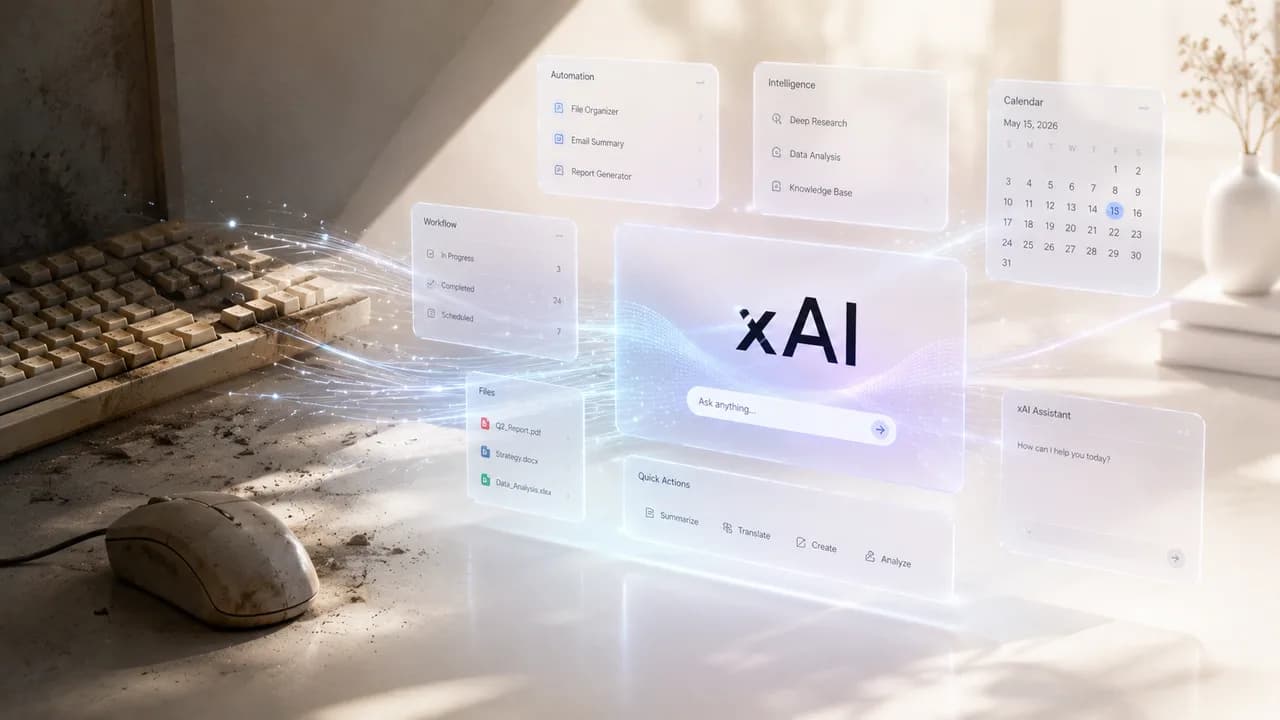
Your Mouse and Keyboard Are Becoming Obsolete: Inside the Rise of Desktop AI Agents
On August 11, 2026, xAI opened the beta for Grok Bot, an AI agent that gets its own cloud computer, logs into your tools with your own credentials, and finishes work even while your laptop is turned off. It is not a chatbot you type questions into. It is a coworker you hand a task to and walk away from. Grok Bot is the latest and loudest entry in a shift that has been building all year: AI agents that operate a computer directly, the same way a person would, rather than waiting for you to click and type every step yourself.
What Actually Launched
Grok Bot lets users create personalized AI agents they message like a colleague and hand tasks off to. According to xAI, each bot operates its own computer environment in the cloud, can log into the tools and services a user already uses, and works across apps, email inboxes, and other software without requiring a clean API integration for every single tool it touches. It continues working in the background and only returns to the user when an approval or a decision is genuinely needed.
The timing is not a coincidence. The launch arrived alongside Cursor, the coding-agent company SpaceX acquired for 60 billion dollars in June 2026, with the two now merging into a single company that presents itself as SpaceXAI. Grok Bot is the first product to come out of that merger, and Elon Musk has already previewed a wider rollout tied to Grok 4.6, the next-generation model, arriving within days of the beta launch.
This Was Already the Direction Everyone Was Heading
Grok Bot did not appear out of nowhere. It is the newest entry in a race that Anthropic and OpenAI have both been running hard all year, and the pattern across all three companies is the same: agents that control a real computer environment, not just a chat window.
Anthropic's Claude Cowork launched as a general desktop agent in January 2026, and by mid-2026 over 90% of its actual usage was not software development at all, it was file organization, research, and document production, the ordinary desk work most people spend their day on. Full desktop control, meaning screen vision paired with a virtual mouse and keyboard the AI operates itself, reached research preview in March 2026. By July, Cowork could run tasks without an active desktop session at all, meaning the agent kept working even after you closed your laptop.
OpenAI took a different structural path but ended up in the same place. The original Operator product, focused on browser-based tasks like form filling and bookings, was folded directly into ChatGPT as agent mode in mid-2025, and Workspace Agents arrived in April 2026 to bring persistent, shared-context agents into team workflows rather than one-off individual tasks. Google's Project Mariner and Meta-owned Manus have both pursued similar computer-use territory from their own angles.
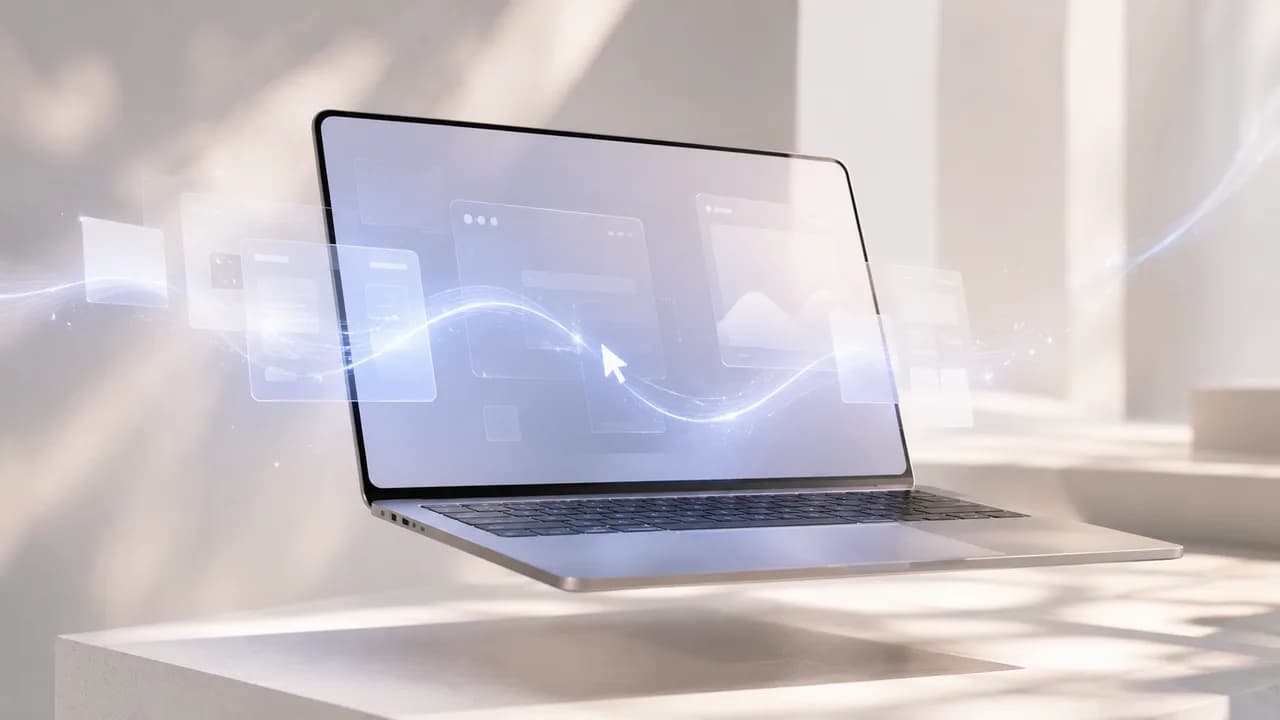
Why "Mouse and Keyboard" Is the Right Way to Think About This
The interesting part of this shift is not that AI got smarter. It is that AI stopped needing a clean API to be useful. For years, automating a task meant a developer had to build a custom integration, script, or workflow connecting one specific tool to another. That worked, but only for tools with an accessible API and only for teams with the engineering time to build and maintain the integration.
A computer-use agent skips that requirement entirely. It looks at the screen the way a person does, clicks the button a person would click, and types into the field a person would type into. That means it can automate a task inside literally any piece of software with a visual interface, whether or not that software was ever designed to be automated. The mouse and keyboard were always the universal interface between a human and any piece of software ever built. What has changed in 2026 is that AI agents can now use that same universal interface directly, which is why they can suddenly work inside old, clunky, internal, or otherwise unautomatable tools that a traditional API-based integration could never touch.
The Part Nobody Should Skip: Permissions and Trust
Handing an AI agent your login credentials and letting it act inside real accounts is a genuinely different risk profile than asking a chatbot a question, and every serious player in this space has had to build guardrails around exactly that concern. Security guidance circulating around Grok Bot and comparable agents centers on the same core principles: enforce zero-trust permissions, restrict each agent's credentials to the minimum scope its specific task actually requires, and run autonomous tasks inside sandboxed, isolated environments rather than granting broad access to a real account or device.
The open-source side of this space has already demonstrated why that caution matters. A grassroots, homemade computer-use agent that went viral in early 2026 saw documented security incidents once people started granting it broad, unsupervised access to their accounts. The commercial platforms, Cowork, Operator, and now Grok Bot, have all built sandboxing and permission scoping specifically in response to that kind of risk, which is a meaningful part of what separates a production-ready agent from an experimental one.
What This Actually Changes for Businesses
The honest headline is not that keyboards are disappearing tomorrow. It is that the default way of getting routine computer work done is shifting from "a person clicks through it manually" to "a person describes the outcome and an agent handles the clicking." That shift matters most for exactly the kind of work that has always resisted automation because it lived inside a messy, non-API tool: legacy internal software, manual data entry between two systems that were never designed to talk to each other, repetitive multi-step tasks buried inside a vendor portal with no integration options.
For businesses, that opens a category of automation that was previously either impossible or prohibitively expensive to build. It also raises the same governance question every one of these platforms is currently wrestling with in public: how much autonomy to grant an agent, and how to audit what it actually did once it has done it.
How Kovazu Thinks About This
At Kovazu, we build AI-powered products and automation systems, and computer-use agents are becoming a genuinely useful tool in that toolkit, not just a novelty. We help businesses figure out where an agent like this can safely automate real work, how to scope its permissions properly, and how to build the surrounding governance so a powerful new capability does not turn into an unmanaged risk. Whether that means integrating an existing agent platform into your workflow or building custom automation around the same underlying computer-use capability, that is the kind of system design we work on.
If you are curious whether an AI agent could take a genuinely tedious, manual part of your business off your plate, let's talk at Kovazu.
The Bottom Line
Grok Bot's August 12 launch is not an isolated event. It is the latest, highest-profile move in a race that Anthropic and OpenAI have both been running since the start of 2026, and the direction is consistent across every major AI lab: agents that operate a real computer the way a person does, rather than waiting inside a chat window for the next typed instruction. The mouse and keyboard are not going away. What is changing is who, or what, is holding them for an increasing share of the routine work that used to require a person sitting there clicking through it step by step.
Written by
Emily CarterSenior Content Strategist & Market Trends Writer
Emily Carter writes about business, branding, SEO, and market trends with a focus on making complex topics easy to understand. She enjoys uncovering the strategies behind successful companies, emerging industries, and shifting consumer behavior. When she's not researching the latest market movements, Emily is exploring digital marketing trends, content strategy, and the evolving relationship between technology and business. Her goal is to create content that's insightful, practical, and worth bookmarking.
Keep reading
 Artificial Intelligence
Mac vs NVIDIA for Local AI: Which Is Better in 2026?
We compare Apple Silicon and NVIDIA GPUs for local AI, using an M5 Mac with 64GB memory and an RTX 5090 with 32GB VRAM to test speed, model size, fine-tuning, power, and cost.
 Artificial Intelligence
How to Use AI in Everyday Life: 30 Practical Ideas
Discover 30 practical ways to use AI in everyday life - from work, studying, and travel to writing, productivity, and smartphone tasks. Learn how AI can save time, boost creativity, and simplify your daily routine.
 Artificial Intelligence
Android 17 & Gemma 4: The Future of AI on Android Phones
Android 17 and Gemma 4 bring powerful on-device AI to phones and laptops. Learn how offline AI, NPUs, privacy, and local inference are changing app development and user experiences.